

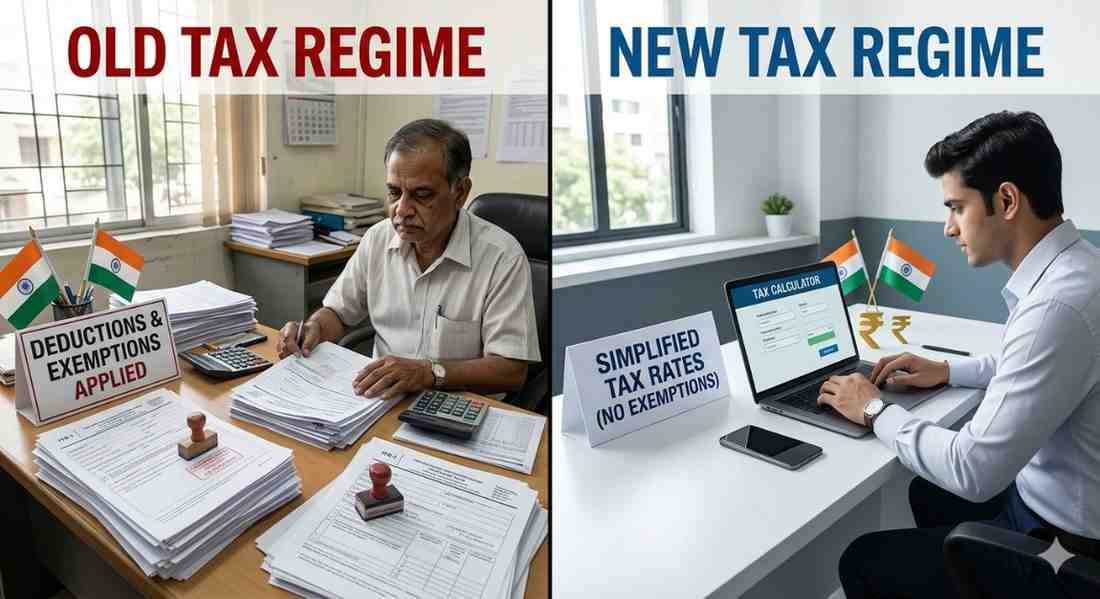
New vs Old Tax Regime:
Every financial year, taxpayers in India face an important decision: should they stick with the traditional, deduction-heavy Old Tax Regime or switch to the simpler, lower-rate New Tax Regime?
Since making the new regime the default option, the government has continuously improved the offer, especially with updates for FY 2025-26. However, the "best" choice varies for each person. It depends on your income level and how much you rely on tax-saving investments.
Here’s a clear comparison of the two regimes, what the latest tax brackets look like, and how to find your break-even point based on your salary.
The Old Tax Regime: The Champion of Deductions:
For decades, India's tax system has encouraged savings and investments. The Old Tax Regime is built around this idea. While its tax rates are higher for those with bigger incomes, it allows you to significantly lower your taxable income through various exemptions.
By using options like the Public Provident Fund (PPF), Equity Linked Savings Schemes (ELSS), health insurance, and home loans, taxpayers can reduce the income figure that the government uses to calculate tax.

Key Features (FY 2025-26):
- Standard Deduction: ₹50,000 for salaried employees.
- Section 80C: Up to ₹1.5 lakh deduction for investments like EPF, PPF, LIC, and ELSS.
- Section 80D: ₹25,000 to ₹75,000 for health insurance premiums.
- Section 24(b): Up to ₹2 lakh deduction on home loan interest for a self-occupied property.
- Allowances: Exemptions on House Rent Allowance (HRA) and Leave Travel Allowance (LTA).
- Tax-Free Limit: With the Section 87A rebate of ₹12,500, income up to ₹5 lakh is effectively tax-free.
The Verdict on the Old Regime:
It can be very profitable if you are paying off a home loan, living in rented housing while receiving HRA, and making the most of your 80C and 80D investments. However, if your cash flow is tight and you can't set aside money in specific tax-saving options, the old regime's higher slab rates will reduce your take-home pay.
The New Tax Regime: The Default of Simplicity:
Introduced in 2020 and significantly updated in recent budgets, the New Tax Regime is now the standard choice for all taxpayers. Its idea is straightforward: provide lower base tax rates for everyone while removing almost all deductions.
The government aims to achieve two things: simplify the tax filing process and give citizens more cash to spend or invest as they wish, without being pushed into specific tax-saving categories.
For FY 2025-26, the new regime is especially appealing for low-to-middle income earners.
Key Features (FY 2025-26):
- Standard Deduction: Increased to ₹75,000 for salaried employees (up from ₹50,000).
- Tax-Free Limit: The Section 87A rebate of ₹60,000 makes income up to ₹12 lakh completely tax-free. When added to the ₹75,000 standard deduction, a salaried person earning up to ₹12.75 lakh pays no tax at all.
- Corporate NPS: The deduction for employer contributions to NPS under 80CCD(2) has risen from 10% to 14% of basic salary.
What You Lose: You will give up more than 70 deductions, including 80C, 80D, HRA, LTA, and home loan interest for self-occupied properties.
Head-to-Head: The Income Tax Slabs for FY 2025-26
To understand the structural difference, look at how the income brackets are taxed. The new regime spaces out the rates much more generously, delaying the dreaded 30% bracket until you cross ₹24 lakh.
Advance Tax Calculator
| Income Slab | Old Tax Regime Rate | New Tax Regime Rate |
|---|---|---|
| Up to ₹2.5 lakh | Nil | Nil |
| ₹2.5L to ₹4 lakh | 5% | Nil |
| ₹4L to ₹5 lakh | 5% | 5% |
| ₹5L to ₹8 lakh | 20% | 5% |
| ₹8L to ₹10 lakh | 20% | 10% |
| ₹10L to ₹12 lakh | 30% | 10% |
| ₹12L to ₹16 lakh | 30% | 15% |
| ₹16L to ₹20 lakh | 30% | 20% |
| ₹20L to ₹24 lakh | 30% | 25% |
| Above ₹24 lakh | 30% | 30% |
Key insight: Under the old regime, an individual crosses into the highest 30% tax bracket the moment their taxable income exceeds ₹10 lakh.
Under the new regime, that 30% rate doesn't trigger until ₹24 lakh. This gap is where the new regime generates massive savings for those without deductions.
The Break Even Point: Crunching the Numbers to Decide:
The decision between the two regimes should not be an intuitive choice. It is a rigorous mathematical computation. What matters most is your break-even point for deductions. This is the exact amount of tax saving deductions that you need to claim to make the old regime cheaper than the new regime.
The new regime has a massive Rs 12.75 lakh tax-free buffer, and the widened slabs, and the break-even point is very high for the financial year 2025-26.
If your total salary is between ₹15 lakh and ₹25 lakh, then you will need to claim about ₹4.5 lakh to ₹5.5 lakh in total deductions for the Old Regime to be worth it.
A Real-World Scenario: Earning ₹18 Lakh
Let's look at two individuals earning ₹18,00,000 a year to see how this plays out.
Person A (The Minimalist):
They don't have a home loan and only claim the standard deduction.
New Regime Taxable Income: ₹17.25 lakh (after ₹75k standard deduction)
Total Tax (New Regime): ~₹1,53,400
If they chose the Old Regime: Their tax would be ~₹2,73,000. The new regime saves them nearly ₹1.2 lakh.
Person B (The Heavy Investor):
They claim the ₹50k standard deduction, maximize 80C (₹1.5 lakh), maximize 80D (₹25,000), and pay heavy interest on a home loan (₹2 lakh under Section 24b). Their total deductions hit ₹4.25 lakh.
Old Regime Taxable Income: ₹13.75 lakh
Total Tax (Old Regime): ~₹1,24,800
If they chose the New Regime: Their tax would be ~₹1,53,400. The old regime saves them roughly ₹28,000.
Test your own salary and investments using this interactive Calculator to see which regime favors your specific financial footprint.
You should choose the New Tax Regime if:
Your gross salary is ₹12.75 lakh or lower (your tax is automatically zero).
You live in your own home (no HRA) and don't have an active home loan.
You prefer having more liquidity in your monthly paycheck rather than locking funds into PF or insurance just to save on taxes.
You are a freelancer or business owner without many traditional salaried deductions.

You should choose the Old Tax Regime if:
You are paying a substantial amount in home loan interest.
You live in a high-rent city and claim a large HRA exemption.
You already comfortably maximize your ₹1.5 lakh 80C limit and maintain robust health insurance policies for yourself and senior citizen parents.
Remember, salaried individuals have the flexibility to switch between the old and new regimes every year based on their evolving financial circumstances.
Visit My Blog Page for Similar Blogs:
Karsaathi Blogs
Here are 10 frequently asked questions (FAQs)
1. What is the main difference between the Old and New tax regimes?
The core difference lies in the balance between tax rates and deductions:
Old Tax Regime: Features higher tax rates but allows you to reduce your taxable income using over 70 exemptions and deductions (like Section 80C, 80D, HRA, and Home Loan interest).
New Tax Regime: Offers significantly lower, concessionary tax rates and simplified tax slabs, but you must give up almost all traditional exemptions and deductions.
2. Which tax regime is the "default" option?
The New Tax Regime is the default option.
3. Can I switch between the old and new regimes every year?
It depends on your source of income:
Salaried Individuals & Pensioners: Yes. You can switch between the old and new regimes every year at the time of filing your Income Tax Return (ITR), depending on which one saves you more money.
Taxpayers with Business or Professional Income: No. If you have business income, you can opt out of the default New Regime to choose the Old Regime. However, once you switch back to the New Regime in the future, you are locked into it for life and cannot return to the Old Regime again.
4. What deductions can I still claim under the New Tax Regime?
While most deductions (like 80C or 80D) are gone, the New Tax Regime still allows a few key benefits for salaried individuals:
Standard Deduction: Salaried individuals and pensioners get a flat deduction.
Employer's Contribution to NPS: Deduction under Section 80CCD(2) for the employer's contribution to your National Pension System account is still allowed.
5. Can I claim House Rent Allowance (HRA) or Home Loan Interest in the New Tax Regime?
No. HRA exemptions and deductions for interest paid on a home loan for a self-occupied property (up to ₹2 lakh under Section 24b) are strictly not allowed under the New Tax Regime.
6. At what income level do I pay zero tax under both regimes?
New Tax Regime: Due to the tax rebate under Section 87A, individuals with a total taxable income up to ₹7 lakh (before standard deduction) pay zero tax.
Old Tax Regime: The zero-tax rebate limit applies to a total taxable income up to ₹5 lakh.
7. Which regime is better for senior citizens?
Under the Old Regime, senior citizens (ages 60–80) and super senior citizens (ages 80+) enjoy higher basic exemption limits (₹3 lakh and ₹5 lakh respectively).
Under the New Regime, there are no separate slabs for senior citizens; the tax slabs and the ₹7 lakh zero-tax rebate apply equally to everyone, regardless of age.
8. Do I need to submit investment proofs to my employer if I choose the New Tax Regime?
No. One of the biggest perks of the New Tax Regime is the minimal paperwork.
9. How do I decide which tax regime is better for me?
It depends entirely on how much you save and invest:
If you do not make heavy investments in tax-saving instruments and don't pay house rent, the New Tax Regime will likely save you more money due to its lower tax rates.
If you fully utilize deductions (e.g., maximizing ₹1.5 lakh under 80C, buying health insurance under 80D, and claiming HRA or a Home Loan), the Old Tax Regime might still result in a lower tax liability.
10. Is there an easy way to compare my tax liability under both systems?
Yes. The Income Tax Department provides a free, official Income and Tax Calculator on its e-filing portal. You can plug in your gross income and your eligible deductions to see a side-by-side comparison of exactly how much tax you would owe under both regimes before filing your return.

Author : Uttam Bisht
26 May, 2026 | 06:04 AM
Mr. Uttam Bisht is a partner with the Delhi Branch of the firm. He has more than 8 years of experience and specializes in Statutory Audit. Expertise in Tax audit of various enterprises. Extpertise internal audit of Private enterprises. Audit planning through business understanding, preliminary analytical procedures, determining materiality levels, and preparation of audit program and pre-audit checklist . He is well conversant with the auditing standards issued by ICAI. .
Tags
Recent Blogs
28 May, 2026 | 04:34 PM
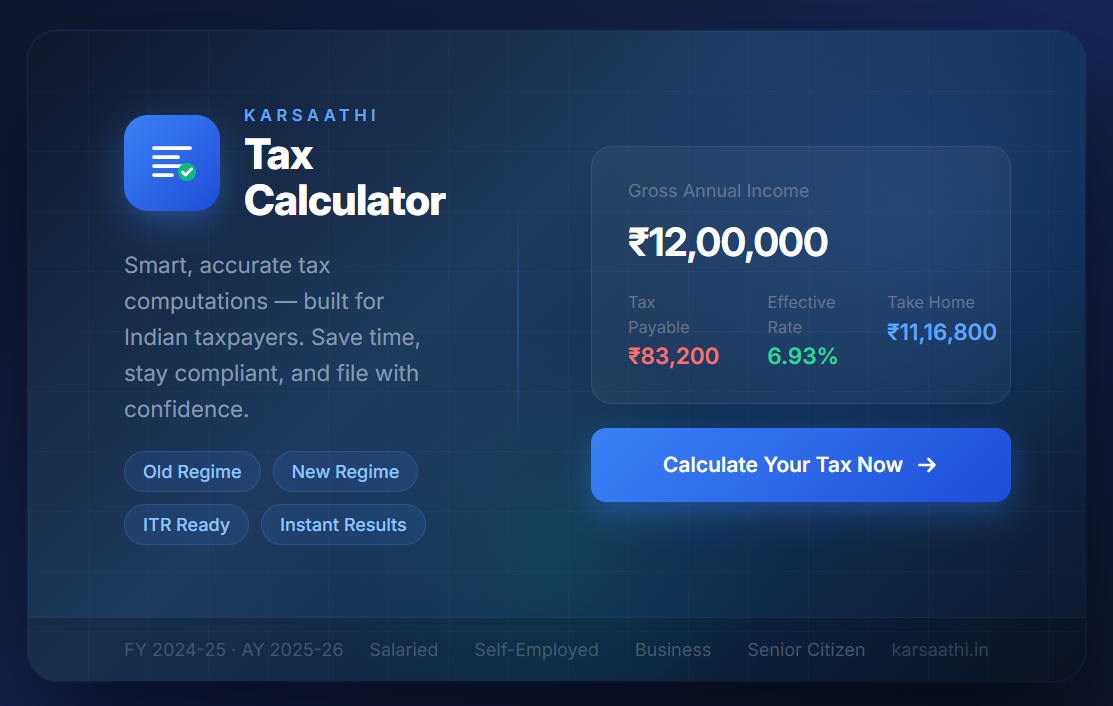
Karsaathi Income Tax Calculator
06 February, 2026 | 07:28 AM
Decoding Union Budget 2026

13 May, 2025 | 07:42 AM
Top 5 Tips for Filing ITR 4 Easily

08 May, 2025 | 01:09 AM
Simple Guide to Filing ITR1 Sahaj

30 April, 2025 | 05:51 AM
Mortgage Rates Today

26 April, 2025 | 10:23 PM
How Bank's are scamming you - Fixed vs Reducing Rate
Popular Blogs

14 February, 2024 | 11:43 PM
Top 15 ITR Filing Documents

21 March, 2024 | 12:29 AM
The Road to Financial Freedom: Leveraging Tax Services for Long-Term Success
13 May, 2025 | 07:42 AM
Top 5 Tips for Filing ITR 4 Easily

27 February, 2024 | 11:20 PM
Why Filing ITR with No Income is Smart

14 February, 2024 | 11:39 PM
21 Ways to Save Tax From Salary
10 October, 2024 | 10:15 PM
